
Société des Missions Africaines – Province d’Irlande
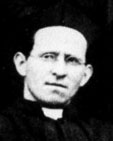 |
né le 11 novembre 1892 dans l’île d’Inishboffin dans l’archidiocèse de Tuam, Irlande membre de la SMA le 9 octobre 1915 prêtre le 14 juillet 1918 décédé le 1er avril 1945 |
1918-1921 Kilcogan, professeur de philosophie décédé à Cork, Irlande, le 1er avril 1945,
|
(biographie en anglais à la suite)
Le père Martin LAVELLE (1892 – 1945)
Le 1er avril 1945, à Cork (Irlande), retour à Dieu du père Martin Lavelle, à l’âge de 53 ans.
Martin Lavelle naquit dans le diocèse de Tuam (Irlande) en 1892. Il fit ses études dans les maisons de la Société en Irlande. Ayant émis le serment en 1915, il était ordonné prêtre le 14 juillet 1918. Le père Lavelle passera sa vie missionnaire comme professeur en Irlande.
Grand travailleur, très doué pour l’enseignement, il enseignera d’abord la philosophie, puis, à partir de 1821, le dogme et l’écriture sainte, au grand séminaire. D’une foi simple et profonde, très régulier dans ses exercices de piété, le père Lavelle fera passer sa vie dans ses cours. Il réussit très bien dans son emploi, malgré une discipline parfois un peu militaire, dit-on. Il avait aussi le don de trouver de l’argent et d’obtenir des services. C’est ainsi que, grâce à sa chronique mensuelle dans le « African Missionary », il pouvait envoyer chaque année aux Missions plusieurs centaines de livres sterling.
Supérieur du grand séminaire de Dromantine en 1937, il était passé à la même charge à Wilton en 1943.
Father Martin F. LAVELLE (1892 – 1945)
Martin Lavelle was born on the island of Inishboffin, off Clifden, Connemara, Co Galway, in the archdiocese of Tuam, on 11 November 1892. He died in St. Joseph’s college, Wilton, Cork, on 1 April 1945.
Martin commenced his secondary education at the Sacred Heart college, Ballinafad, Co Mayo, in 1908, completing it at St. Joseph’s college Wilton, which he entered in 1911. Martin went to the Society’s major seminary at Blackrock Road, Cork, in 1913. He was admitted to membership of the Society on 9 October 1915, and was ordained a priest by Bishop Daniel Cohalan of Cork diocese, at St. Mary’s cathedral, Cork, on 14 July 1918. Ordained with him on that day was William Porter, later archbishop of Cape Coast.
Martin was ordained six years after the Irish Province had been founded. Up to that time the professors in the Province’s major seminary had been diocesan priests seconded to the Society by their bishops and who were invariably alumni of St. Patrick’s college, Maynooth. One notable professor was William Ferris of Kerry diocese, a cousin of Maurice Slattery, the Irish Provincial Superior. Martin was among the first from within the ranks of the Province to be assigned to the teaching staff of the major seminary. A gifted teacher he was to spend most of his priestly life in the colleges of the Irish Province. First of all, appointed in the very month of his ordination, he taught philosophy to the 24 aspirants in the Society’s novitiate and house of philosophy which had been opened in September 1918 at Kilcolgan, Co Galway. Maurice Slattery, who in the same year had been succeeded as Provincial by William Butler, was superior in Kilcolgan; other members of staff were John Ahern (bursar) and Brother Danny O’Connell (who later became a priest).
In June 1921 Martin was transferred to St. Joseph’s seminary, at Blackrock Road, where he was entrusted with the chairs of dogmatic theology and sacred scripture. Michael Collins, who taught moral theology, liturgy and homiletics, was superior. Other members of staff were Michael McCaffrey who taught pastoral theology, and Stephen Harrington who taught canon law and Church history. Martin became one of the mainstays of this seminary, which was the first college for ‘foreign’ missions established in Ireland – in 1909. When Martin came on the staff there were 30 students in training, in a cycle of four years. By 1925 there were 45 students in a building which was far too small to accommodate them. In 1926 the seminary was re-located to a fine spacious house with extensive lands, near Newry, Co Down, called Dromantine. Martin was one of those who transferred to Dromantine with the students. William Butler, who had been succeeded by Maurice Slattery at the Assembly of 1925, was superior of the seminary and professor of pastoral theology. In 1931 Martin was nominated vice-superior to William Butler’s replacement, John Cadogan. Finally, in 1937 Martin became superior of the seminary which now had 62 students in formation. Despite his extensive administrative duties he continued to teach dogmatic theology. He was to remain in charge of Dromantine until 1943.
Thereafter, up to the time of his death, Martin was to serve as superior of the apostolic school at Wilton where candidates for the Society studied for their leaving certificate in a three year cycle. In March 1944 he visited Innishboffin for the funeral of his father. He himself died a year later, after a long illness. The director of students, Joe Stephens, who attended him at the end, wrote to his Provincial: ‘I am very happy he got such a holy death and I was privileged to assist him. He was a father and friend to me and I feel his loss immensely. He had a most peaceful and holy death at 7.10 a.m. Easter Sunday morning.
Martin had another life. For many years he edited a highly popular column in the African Missionary , the Province’s magazine (founded in 1914), directed towards young people. The column, written with much imagination and full of competitions, games and puzzles as well as features on missions and missionaries attracted considerable sums of money from its young readers which were sent annually to the various missions. It also did much to foster vocations to the missionary life. Martin’s younger brother, John, born in 1898, was a member of the Society. He predeceased Martin by ten years. Two other Inishboffin men who joined the Society were the brothers Martin and George Lacey.
He is buried in Wilton cemetery.