
Société des Missions Africaines – Province d’Irlande
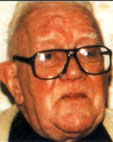 |
né le 4 août 1916 à Castlebar dans l’archidiocèse de Tuam, Irlande membre de la SMA le 29 juin 1937 prêtre le 22 décembre 1940 décédé le 28 août 1997 |
1942-1951 vicariat d’Asaba-Benin, Nigeria décédé à Cork, Irlande, le 28 août 1997 |
Father Michael Augustine McFADDEN (1916 – 1997)
Michael McFadden was born in Castlebar, Co Mayo, in the archdiocese of Tuam, on 4 August 1916. He died in university hospital, Cork, on 28 August 1997.
From Lower Chapel St., Castlebar, Michael was the eldest of a family of two boys and two girls born to Margaret (née Harrison) and John McFadden who worked as a nurse in St. Mary’s hospital, Castlebar. In 1922, when Michael was only six years old, tragedy struck the family when his mother died in childbirth. Henceforth the children were brought up by an aunt. Michael completed his primary education at St. Patrick’s national school, Castlebar, in 1930. He then went to St. Jarlath’s college, Tuam, for his secondary education. His first contacts with the S.M.A. came through Tony McAndrew, the superior of the Society’s novitiate and house of philosophy at Kilcolgan, Co Galway, who came to St. Jarlath’s in 1934 to talk about the missions. Matriculating and taking his leaving certificate in 1935 Michael entered Kilcolgan in September 1935. He received his theological formation in the Society’s major seminary, at Dromantine, Co Down, between 1937 1941. Michael was received as a member of the Society on 29 June 1937 and was ordained a priest in St. Colman’s cathedral, Newry, Co Down, by Bishop Edward Mulhern of Dromore, on 22 December 1940. He was one of a group of nineteen ordained on that day. He celebrated his first Mass in the church of Our Lady of the Holy Rosary where he had been baptised, confirmed and received his First Holy Communion.
After ordination Michael returned to Dromantine for a further six months to complete his theology course. He was then appointed the vicariate of Western Nigeria, a territory which a year later (January 1943), was to be re named the ‘vicariate of Asaba Benin’, to reflect more accurately its geographical location. It was to be erected as the diocese of Benin city in 1950. The jurisdiction covered a vast territory, some 58,000 square kilometres with 1,700,000 inhabitants, now divided into an archdiocese and three dioceses. Because of difficulty in securing a sea passage in wartime, Michael’s departure for Africa was delayed until February 1942 when eventually he sailed on the Bergensfiord’, in a shipping convoy out of Glasgow. There were large numbers of troops on the ship, bound for the Far East. In early March they reached Freetown, Sierra Leone, where they transferred to the Ulster Monarch. Michael disembarked at Lagos, going by train to Oshogbo and from there by road to Benin and Asaba. Patrick J. Kelly, the vicar apostolic, posted him to Asaba, where, under the watchful eye of the superior, Tom Duffy, he was introduced to the missionary life, learning the local language, studying local customs and undertaking supervised pastoral work. After six months he passed his ‘canonicals’ examination and was given faculties to hear confessions by Bishop Kelly.
He was now appointed to Kabba, a mission with numerous outstations, all of which had to be visited by motor cycle. Here his ‘parish priest’ was John R. (Jock) Duffy. In May 1943 he was transferred to Okene, returning to Kabba in January 1944, and joining there Ned Coleman who was now ‘parish priest’. In June 1945 Michael picked up a serious foot infection and was invalided to Ireland. He spent one year at home receiving treatment in St. Vincent’s hospital, Dublin. On his return to Nigeria in June 1946 he was assigned to the staff of the teacher training college at Ubiaja. Here, under the principalship of John Lyons, he made a signal contribution to the educational apostolate for a period of three years. He spent the remainder of this second tour of duty (a tour of five years) 1949 May 1951 in Okene where he took over from Joe Conboy.
In July 1952, after returning from leave, Michael was appointed to Benin city mission. After two months Bishop Kelly sent him to Aghalokpe and gave him responsibility for the construction of Immaculate Conception secondary college. When this work was complete he was posted to Ibusa. In 1953 the Ibadan region, in south western Nigeria, was detached from the archdiocese of Lagos and erected as a prefecture apostolic under the leadership of Richard Finn. Michael was appointed a member of Mgr. Finn’s staff and was posted to Oke Offa mission in October. Six months later he was transferred to Oke Ado where he was to minister for the next three years. In April 1958 the prefecture was erected as a diocese and Michael, who had been assistant in Oke Ado, became parish priest. In February 1960 Bishop Finn despatched Michael to the U.S.A. on a fund raising mission, after which he returned to Ireland on leave. Michael was to serve in Ibadan diocese he spent most of his time as parish priest in Oke Ado until June 1967. He is remembered by the people as an energetic and wise missionary. He is also remembered for his building skills shown to great advantage in the new church of St. Joseph which he built in Oke Ado with the assistance of the talented John Travers. By his confrères he is best remembered as an enthusiastic card player and as a most gracious host.
After his departure from Nigeria Michael took up a pastoral appointment in the archdiocese of New York. He was to minister in this jurisdiction for the next eighteen years, until 1986. He worked, first, for six years in the Bronx (Shrine church of St. Ann, Bainbridge Avenue) and then transferred upstate to Saugerties (Church of Mary of the Snow, Post and Cedar Sts.) where he spent twelve very happy and rewarding years. Michael spent his years of retirement in Dromantine, although he returned frequently to New York each summer to do supply work. He spent happy years of retirement in Dromantine, enjoying relatively good health apart from a knew replacement operation in 1990. However in the summer of 1996 he suffered a stroke. As a consequence of increasing health problems Michael came to the Society’s retirement home at Blackrock Road in March 1997. His health continued to deteriorate. He had a cataract removed from his eye in June 1997 and a month later he fell and damaged the eye. On August 25 he was admitted to Cork university hospital and had the eye removed. On August 26 he suffered a stroke and died peacefully two days later.
Michael had a great capacity for friendship. His mail was always large and during his final illness there were constant phone calls many of them from America asking about him. The attendance at his funeral was another demonstration of the many friends which he had made over a long life.
He is buried in Wilton cemetery.